“If you shave your facial hair once, it will grow back even thicker.” Laser hair removal specialists hear this concern all the time. It is especially common among women who are advised to shave facial hair a day before their appointment. For many, this recommendation raises an immediate concern: what if the hair becomes coarser, darker, or starts growing faster?
In reality, this fear is not limited to laser hair removal. The belief that frequent shaving makes hair grow back faster has been around for generations. Because of it, many people avoid shaving their arms, face, abdomen, or other areas of the body out of concern that the hair will come back thicker than before.
But is there any scientific basis for this belief? Does shaving actually affect hair growth? In this article, we’ll explore where this myth came from, why hair can seem thicker after shaving, and what modern scientific research has discovered about the relationship between shaving and hair growth.
Where Did the Myth About Shaving and Thicker Hair Come From?
If shaving really made hair grow back thicker, barbers would have solved baldness with a razor long ago. Yet despite making little biological sense, this myth has persisted for decades.
The reason for its popularity is fairly simple. After shaving, many people genuinely feel that their hair grows back faster, looks thicker, and becomes more noticeable. At first glance, it seems like obvious proof: before shaving, the hair felt soft and fine, but afterward it appears coarser, stiffer, and darker.
In reality, this effect is largely a matter of perception. Imagine a tree branch. Its tip gradually narrows and becomes thinner. If you cut that branch with pruning shears, the cut end will look thicker and rougher. Something very similar happens with hair.
A hair that has been growing naturally for a long time develops a soft, tapered tip. When you shave, the razor cuts it straight across. As the hair grows back, the first part to emerge from the skin is no longer the naturally thin tip but a wider section of the hair shaft. As a result, the hair appears thicker and feels coarser.
There is another factor as well. Short hairs tend to stand more upright and bend less under their own weight. Because of this, they are easier to feel when touched and often look more noticeable than longer hairs.
As a result, people experience a very convincing illusion that shaving affects hair growth. In reality, the only thing that has changed is the appearance of the hair after it has been cut.
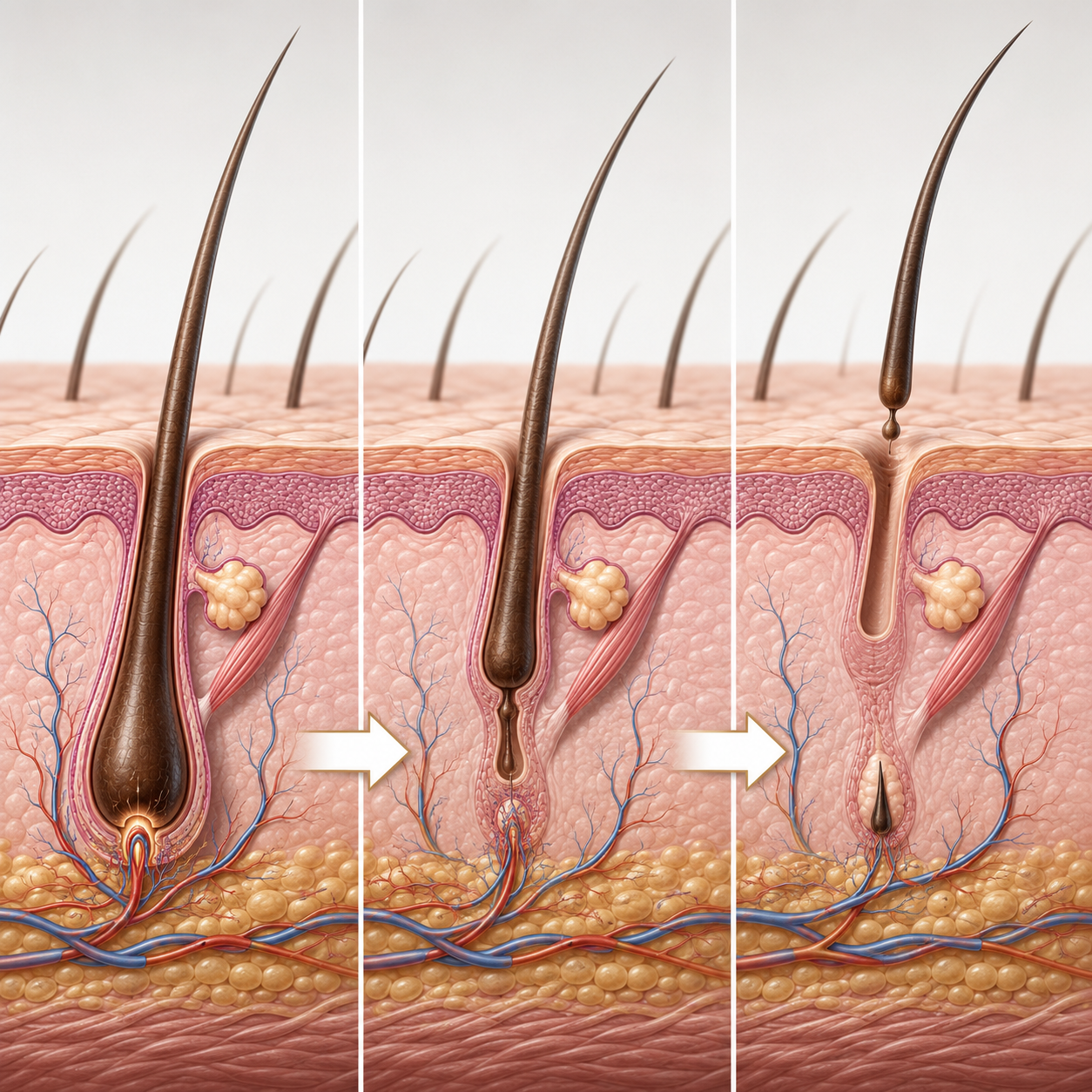
To understand why shaving does not affect hair growth, it helps to understand where hair actually grows. The portion of hair that you see above the skin is essentially a biologically “dead” structure. It consists primarily of keratin, a protein that no longer participates in the body’s metabolic processes. Hair above the skin cannot be revived, strengthened, or made to grow faster—just as you cannot speed up nail growth by trimming the free edge of a nail.
The real control center lies much deeper, inside the hair follicle. This is where cell division takes place, new hair is formed, and the characteristics that determine hair thickness, color, and growth rate are established.
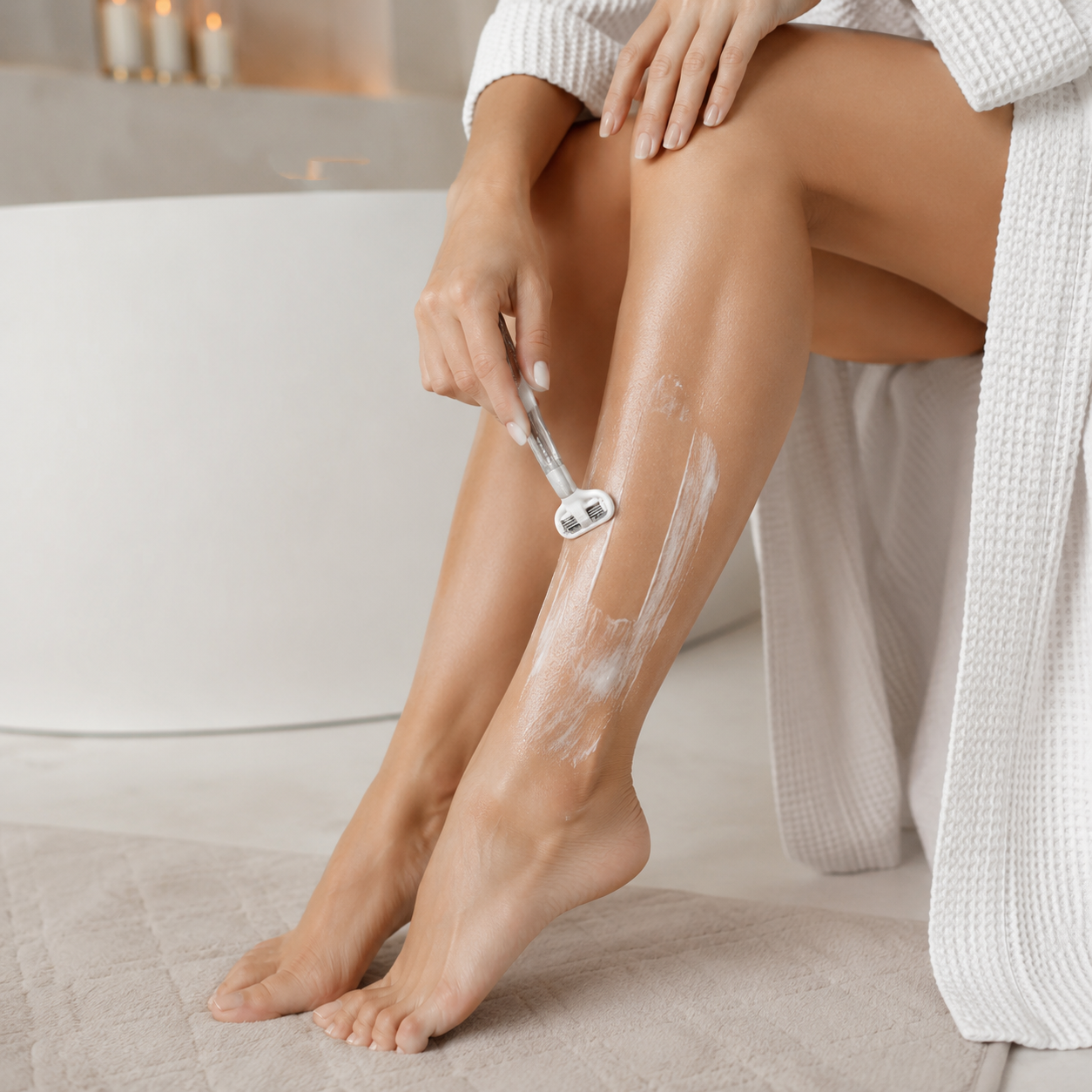
During shaving, the razor only comes into contact with the part of the hair that is already above the skin’s surface. The hair follicle remains completely untouched. A razor cannot reach deep enough to interact with the cells responsible for hair growth.
From a biological standpoint, shaving simply has no mechanism that could make hair thicker, darker, or more numerous. For that to happen, the function of the hair follicle itself would need to change—and an ordinary razor is incapable of doing that.
That is why dermatologists, hair-loss specialists, and researchers have long considered the idea that frequent shaving speeds up hair growth to be a myth.
What Actually Determines Hair Growth?
If shaving does not affect hair growth, what does?
In reality, the characteristics of your hair are determined by processes taking place inside your body. That is why some people naturally have thick, dense hair, while others have finer or sparser hair.
Hair growth, thickness, and density can be influenced by:
genetics;
hormone levels, especially androgens;
age;
individual biological factors;
certain medical conditions;
specific medications;
nutrition and overall health.
For example, hormonal changes can cause facial hair in women to become more noticeable or begin growing in new areas.
This is an important point that is often overlooked. If your hair seems thicker after several years of shaving, that does not mean shaving increased its density. More likely, other factors were affecting the hair follicles during the same period.
For this reason, experts view shaving as nothing more than cutting hair to a very short length. After all, no one believes that regularly trimming the ends of the hair on your head can make it grow thicker. The same principle applies to hair on the face, arms, legs, and other parts of the body.
How the Hair Growth Cycle Works
Another argument against the myth that shaving affects hair growth comes from the biology of hair itself. Every hair on the body goes through its own growth cycle, which is initiated and regulated by the hair follicle.
This cycle consists of three main phases:
Phase
What Happens
Anagen
The hair is actively growing. Depending on the area of the body, this phase can last anywhere from several months to several years.
Catagen
Hair growth gradually stops, and the follicle begins transitioning into a resting state.
Telogen
The hair sheds, and after some time a new hair begins growing from the same follicle.
Interestingly, different hairs in the same area of skin can be in different phases of the growth cycle at the same time. That is why hair does not all fall out or grow back simultaneously.
Why the Hair Growth Cycle Matters When It Comes to Shaving
Shaving does not alter the hair growth cycle in any way. A razor cannot move a hair from the telogen phase into the anagen phase, accelerate cell division inside the follicle, or cause the body to create new hair follicles.
What’s more, the number of hair follicles a person has is largely determined before birth. If a particular area of skin contains, say, 1,000 active follicles, shaving will not increase that number to 1,200 or 1,500.
This leads to an interesting conclusion. For the myth of “thicker hair after shaving” to be true, a razor would somehow have to penetrate beneath the skin, influence follicle cells, alter hormonal processes, and even create new hairs. Obviously, none of these things happen during shaving.
But if biology tells us one thing, why do so many people still wonder whether frequent shaving affects hair growth? To answer that question once and for all, it helps to look at the scientific evidence.
Does Frequent Shaving Affect Hair Growth? What the Research Says
One of the strengths of the scientific method is that it allows even the most common beliefs to be tested. If millions of people believe that shaving makes hair grow back thicker, that claim can be examined through controlled research.
One of the most frequently cited studies on this topic was published in 1970 in the Journal of Investigative Dermatology. Researchers Yelva L. Lynfield and Peter MacWilliams set out to determine whether regular shaving had any effect on hair growth rate or hair thickness.
During the study, participants regularly shaved hair from specific areas of skin, while nearby areas were left untouched and served as controls. This design allowed researchers to compare changes within the same individual while minimizing the influence of genetics, age, and other personal factors.
The researchers evaluated several aspects of hair growth, including:
hair regrowth rate;
hair shaft thickness;
the appearance and density of body hair.
The results were clear: regular shaving produced no significant changes in any of these measurements. In other words, shaving does not affect hair growth. Any visual changes are simply the result of the blunt edge created when the hair is cut, which can make regrowing hair appear thicker.
In essence, the findings confirmed what biology would predict. Shaving affects only the portion of the hair shaft that extends above the skin and does not influence the structures responsible for hair growth.
Why Does the Myth Still Exist?
Interestingly, even after studies like these were published, the myth never disappeared. One reason is that personal experience often feels more convincing than scientific evidence. If hair feels coarser after shaving, people naturally conclude that the hair itself has changed. In reality, what has changed is not the hair’s biology but its shape after being cut. This effect creates the illusion of thicker, denser hair growth.
As a result, we end up with a curious paradox. Science has provided a clear answer to the question of whether shaving affects hair growth for decades, yet the myth continues to be passed down from one generation to the next.
Why Does Hair Seem Thicker After Shaving?
If shaving does not affect hair growth, why are so many people convinced that it does? The answer is that our perceptions do not always reflect what is actually happening. When it comes to hair, several factors combine to create a very convincing illusion of increased growth.
Reason #1: The Tip of the Hair Changes Shape
This is the most important factor. Naturally growing hair gradually tapers toward the end, creating a soft, fine tip. When you shave, that tip is removed, and the hair grows back with a blunt end.
As a result, the hair may appear thicker and feel coarser to the touch. It is important to understand that the hair itself has not become thicker. You are simply seeing the cut end of the hair rather than its naturally tapered tip.
Reason #2: Short Hair Is More Noticeable
Longer hairs tend to bend under their own weight and lie closer to the skin. Short hairs behave differently. They remain more upright and stand almost perpendicular to the skin’s surface.
Because of this, they are easier to see and easier to feel when you run your hand over the area. That is why a few millimeters of stubble can seem denser than hair that is several inches long.
Reason #3: We Pay More Attention to It
There is also a psychological effect at work. After shaving, people often start examining the treated area more closely. Something they previously ignored suddenly becomes the focus of attention.
Imagine buying a new car. Within days, it may seem as though the same model is everywhere on the road. In reality, the number of those cars has not increased—you simply notice them more often. A similar phenomenon occurs with hair.
Reason #4: Correlation Is Mistaken for Causation
Sometimes people begin shaving during a period when their hair is naturally becoming more noticeable. This may happen because of hormonal changes, aging, or certain medical conditions.
In these situations, it is easy to draw the wrong conclusion: the hair changed after shaving, so shaving must have caused the change. However, just because one event follows another does not mean the two are related.
Why It Feels Like Shaving Affects Hair Thickness: A Quick Summary
When people believe that shaving affects hair thickness, they are usually observing one or more of the following effects:
hair appears thicker because of the blunt cut;
short stubble feels rougher to the touch;
hair becomes more visually noticeable;
people pay closer attention to regrowth;
real changes caused by other factors are mistakenly attributed to shaving.
So the feeling that hair has become coarser after shaving can be completely real. The answer to the question, “Does shaving make hair thicker?” however, remains the same: no.
When it comes to the arms, legs, or underarms, most people view shaving as a routine part of personal care. But when facial hair enters the conversation, the situation changes.
Facial hair is often the area that raises the most concerns for women and leads to questions such as, “Does shaving affect hair growth?” Many women are perfectly comfortable shaving their legs for years, yet the idea of using a razor on the upper lip, chin, or cheeks can feel intimidating.
This concern is well known among laser hair removal professionals. Many women worry that shaving facial hair will cause it to grow back faster, become coarser, or eventually turn into visible stubble.
Can Shaving Cause a Woman to Grow a “Beard”?
The short answer is no. A razor cannot change hormone levels, alter the sensitivity of hair follicles to hormones, or transform fine vellus hairs into terminal hairs.
If such a mechanism existed, medicine would already be using it to treat various forms of hair loss. In reality, even modern hair-growth treatments work by influencing complex biological processes within the hair follicle—not by mechanically cutting hair above the skin’s surface.
Why Do You Need to Shave Before Laser Hair Removal?
Our laser hair removal specialists regularly meet clients who are concerned about having to shave before their treatment. However, according to modern scientific understanding, these concerns are unfounded. Whether you shave once or shave regularly, it will not change the number of hairs you have, their thickness, or their growth rate. Proper preparation, on the other hand, can help make laser hair removal more effective.
This naturally leads to an important question: if the hair is going to be removed by the laser anyway, why shave it first? At first glance, the recommendation may seem strange. The reason is directly related to how laser hair removal works and how laser energy reaches the hair follicle.
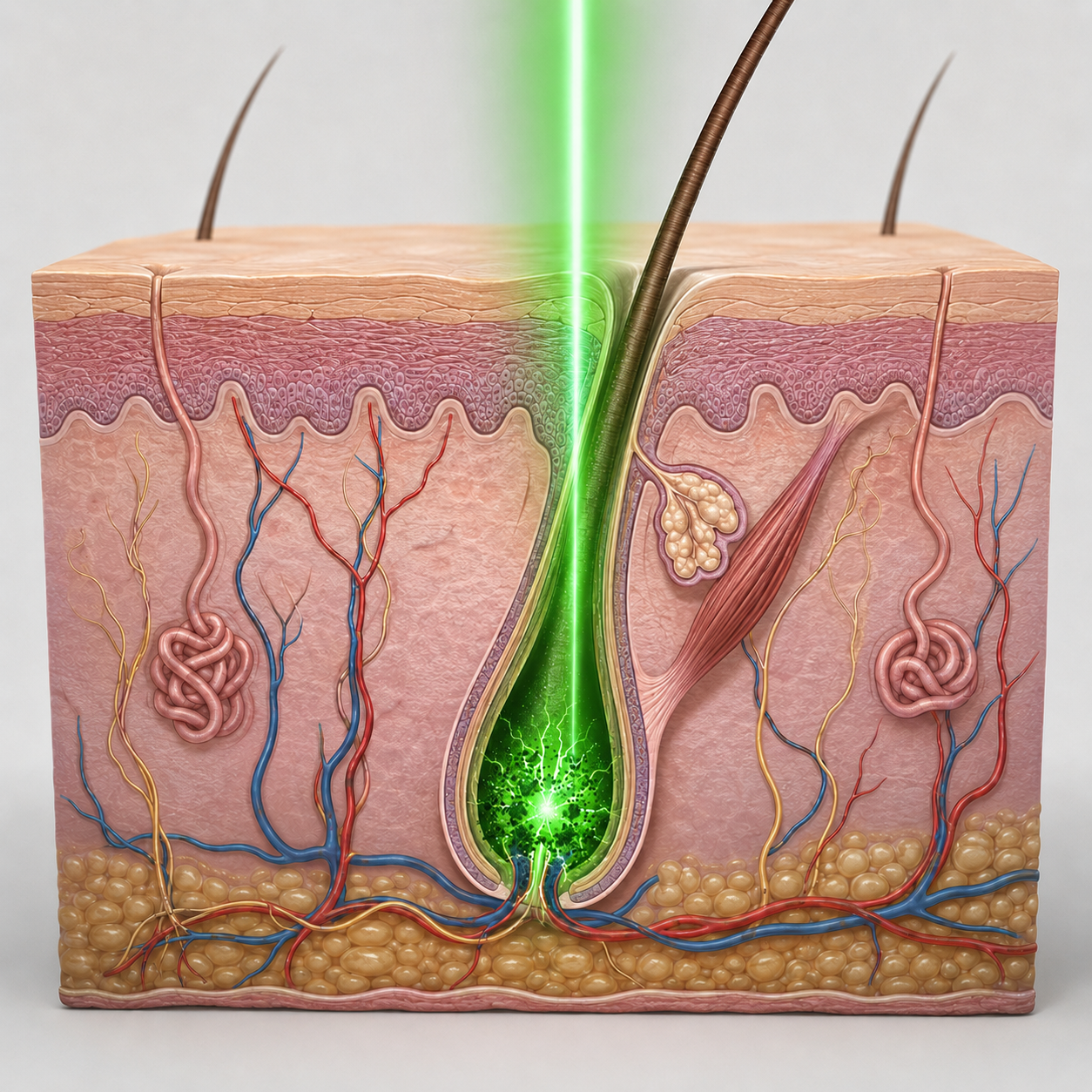
Simply put, the laser does not target the visible portion of the hair above the skin. Instead, it targets structures inside the hair follicle. This is where melanin is located—the pigment that absorbs the laser’s energy and plays a key role in damaging the follicle.
When hair is too long, part of the laser energy is absorbed by the hair above the skin before it can reach the desired depth. This can reduce the effectiveness of the treatment and cause unnecessary heating of the hair at the skin’s surface.
For this reason, specialists typically recommend shaving the treatment area approximately 24 hours before a laser hair removal session.
Conclusion
The myth that shaving affects hair thickness has been around for decades. However, neither modern knowledge of hair biology nor scientific research supports this claim.
All a razor does is cut the visible portion of the hair above the skin’s surface. It does not affect the hair follicle, alter hormone levels, or cause hair to grow faster, become thicker, or increase in number.
In short, the facts are clear:
shaving does not increase the number of hairs;
shaving does not make hair grow faster;
shaving does not make hair thicker;
shaving does not change hair color;
shaving does not affect the function of hair follicles;
shaving cannot cause women to develop a “beard.”
The impression that hair becomes coarser or denser after shaving is mainly due to the fact that the hair is cut straight across. As a result, the regrowing stubble looks and feels different, even though the hair itself remains exactly the same.
If concerns about shaving have been holding you back from trying laser hair removal for your face, you can confidently cross that fear off your list. Ready to see the results for yourself? Schedule your free consultation today!
Sign up and get a discount!
Frequently Asked Questions About Shaving and Hair Growth
⚫️ Does shaving make hair darker?
No. Shaving does not affect hair color. However, hair may appear darker after shaving because the thicker part of the hair shaft becomes visible above the skin. In addition, short hair often creates more contrast against the skin. This is why many people believe their hair has become darker after shaving, even though its actual color has not changed.
🐥 What happens if you shave vellus hair?
In most cases, nothing unusual happens. Vellus hair does not turn into terminal hair simply because it has been shaved. After being cut, it may temporarily appear more noticeable because it grows back with a blunt tip. However, the hair’s structure, growth rate, and the function of the follicle remain unchanged.
🍀 Does shaving your head make hair grow back thicker?
No. This is one of the most common hair myths. After shaving your head, hair may appear thicker because all of the hairs are the same length and have blunt ends. However, neither the number of hairs nor their actual thickness changes. If shaving truly increased hair density, it would already be used as a treatment for hair loss.
🦚 Why does it seem like there is more hair after shaving?
In reality, there is not. After shaving, hair is shorter and grows back with a blunt tip. This can make it appear thicker and more noticeable. In addition, people tend to pay closer attention to the shaved area as the hair grows back. Together, these factors create the impression of increased hair growth, even though shaving does not affect hair growth at all.
🦔 Why shouldn’t you shave against the grain?
Shaving against the grain is not prohibited, but it is more likely to cause discomfort. The razor places greater stress on both the skin and the hair, which can increase the risk of minor skin irritation, redness, ingrown hairs, and post-shave discomfort. This is especially true for people with sensitive skin or coarse hair.
🪒 Does shaving affect hair growth?
No. Shaving removes only the portion of hair that is above the skin’s surface. The hair follicle, which controls hair growth, remains untouched. Because of this, shaving cannot make hair grow faster, increase the number of hairs, or change their thickness. Hair may look different after shaving, but its biological characteristics remain the same.
We use cookies to personalize content and ads, provide social media features, and analyze our traffic. We also share information about your use of our site with our social media, advertising, and analytics partners. Learn more
Your application has already been successfully sent!















No reviews