



How does skin phototype affect the effectiveness of laser hair removal?
Contents
You’ve probably heard about the differences in skin types and how these differences can affect the effectiveness of laser hair removal. Let’s take a closer look at whether this is really the case and whether it’s something to pay attention to.
What is “skin phototype” and where does this concept come from?
The classification of skin into “phototypes” was introduced quite a while ago, in 1975, by the well-known American dermatologist Thomas Fitzpatrick. He was among the first to notice that skin of different shades reacts differently to ultraviolet radiation. However, these discoveries were made in the context of treating psoriasis with photochemotherapy, not in relation to laser exposure. Dr. Thomas was involved in treating psoriasis using photochemotherapy at that time. At that time, to determine the dosage of the methoxsalen drug, doctors relied only on the color of the patient’s eyes and hair, not considering skin color. However, they gradually concluded that the color of hair and eyes alone was insufficient for accurately determining the medication dosage, as the dosage used for light-skinned individuals turned out to be excessive for patients with dark skin. This led Dr. Fitzpatrick, based on his extensive experience, to propose a conditional scale for classifying skin into “phototypes.” This scale of skin shades is now known as the “Fitzpatrick skin phototypes.”
Since Dr. Fitzpatrick specifically relied on treatment methods involving “ultraviolet light,” his research became a significant foundation for further studies on this topic. Thus, the classification into phototypes proposed by this scientist has been widely adopted and is actively used today in many fields.
So, we’ve established that skin color and its reaction to sunlight are directly related. It’s worth noting that determining your skin’s phototype is done purely “by eye.” There is no specialized equipment to assist in this.

Can you determine your skin phototype yourself?
Certainly – yes. And in determining it, we will rely not only on skin color but also on your experience with sun exposure.
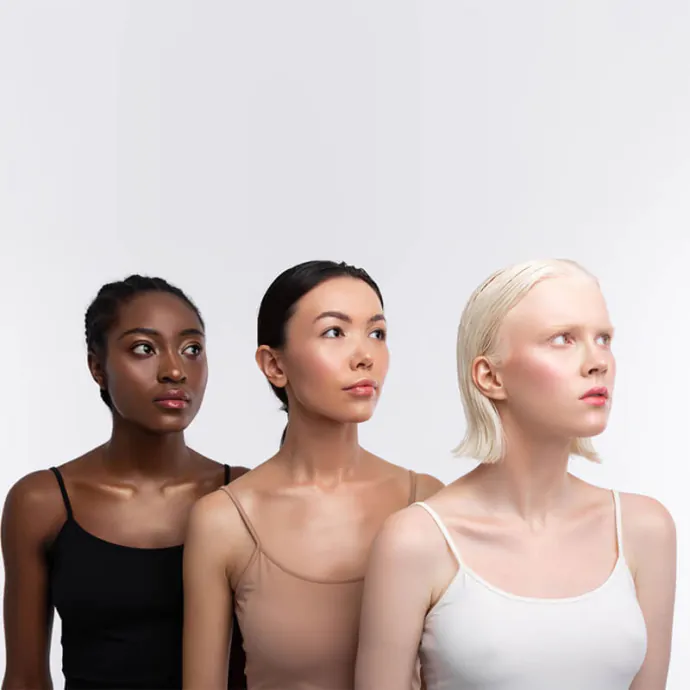
Phototype 1 – very light skin. This includes albinos and natural blondes. Skin and hair are light. The skin is extremely vulnerable to the sun, contains very little or no melanin, which almost always results in sunburn. Sunscreens with the highest SPF are recommended for safe sun exposure.
Phototype 2 – light skin. Light brown hair, natural dark blondes. This skin is still quite sensitive to ultraviolet light but can tan slightly with sunscreen. Without sunscreen, this skin type is very prone to severe sunburns.
Phototype 3 – “medium European skin.” This skin can be quite light naturally but tans well. The risk of sunburn is lower compared to the first and second phototypes. With SPF 25 or SPF 30, you can achieve a beautiful and even tan quickly.

Phototype 4 – “Mediterranean skin.” This skin has a light brown hue and contains a good amount of melanin. Tanning for this skin is relatively safe even without sunscreen. It always tans beautifully and quickly, so the risk of sunburn is minimal.
Phototype 5 – “Indonesian skin.” This skin contains a lot of melanin and has a brown color. It has natural sun protection and is resistant to burns. People with this phototype never get sunburned and don’t need sunscreens. Their skin responds very well to the sun and can become even darker with tanning.
Phototype 6 – “African skin.” This is the darkest of all possible skin tones. The melanin content in the skin is maximal from birth. This skin cannot be “burned” by the sun, as natural sun protection is provided by nature, so it does not need sunscreens.
Interestingly, the color of emoji icons in Telegram is designed with these phototypes in mind, with the exception that Phototypes 1 and 2 correspond to one (the lightest) emoji.
So, we’ve already looked at the classification by phototypes and know how to determine them. The following question remains open.
How does skin phototype affect laser hair removal?

We have talked a lot about the effect of ultraviolet radiation on the skin. However, laser is a completely different type of light, so how do “skin phototypes” come into play?
Indeed, ultraviolet radiation affects only the upper layers of the skin, causing it to produce a large amount of melanin, which gives our skin a tanned appearance. Laser radiation penetrates deeper layers of the skin and does not affect its color. However, there is a specific feature – the principle of laser hair removal is to destroy hair follicles located in deeper skin layers by targeting the melanin pigment present in them – the same pigment produced in the skin during tanning. A hair that contains enough melanin (which makes the skin darker) absorbs a lot of heat and is destroyed by it. Therefore, after laser treatment, such a hair will no longer grow and will be painlessly pushed out of the skin.
Since hair follicles are located at different depths in different skin areas, laser equipment is designed so that the technician can adjust the depth of laser penetration and the power of exposure to the chosen skin area. Therefore, if the skin is naturally rich in melanin, the laser may damage not only the hair follicles we want to remove but also the skin itself, potentially causing an external thermal burn. This was often the case with older equipment and lasers.
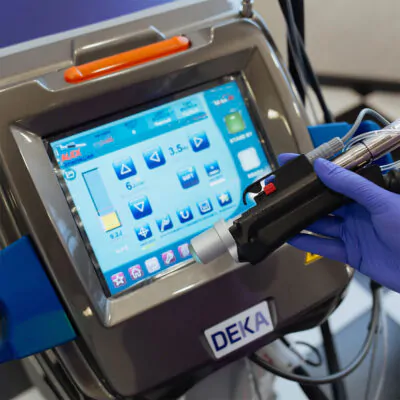
However, modern equipment used by laser hair removal specialists at LaserVille does not have such limitations. The latest laser device called MOTUS AX from the manufacturer DEKA has removed many of the previous limitations. The new method of performing the procedure is movement-based, using the patented MOVEO technology. The constant movement of the applicator prevents “overheating” of the skin. Additionally, the laser is equipped with a unique cooling tip with a sapphire end, which prevents your skin from “overheating” or getting burned. As a result, the procedure on the MOTUS AX equipment is completely painless on ALL, even the most sensitive skin areas. There is no need to use any anesthetic creams before or after the procedure.
What does skin phototype affect then?
 Skin phototype is primarily considered to select the optimal individual settings for the laser equipment. Even for people with tanned skin, effective hair removal is possible. The laser settings will be chosen in such a way that you will not experience any burns, and the desired result will be achieved quickly.
- Skin phototype affects the overall duration of the course. For example, if you have recently tanned, softer settings will be chosen for you, considering your “sun baths,” to avoid damaging your skin. For people with darker skin, a few more sessions may be required than usual, but tanning (or naturally dark skin) is no longer a contraindication for the procedure.
- If you have very light skin and hair (provided you are not an albino and the hair you want to remove is not gray), the procedure is also possible. But, as in the previous case, the course will be longer than usual because light hair contains very little melanin.
- The shortest course for complete hair removal (6 sessions) is possible under ideal conditions, where you have very dark hair and relatively light skin, which is more typical for the third phototype.
 Skin phototype is primarily considered to select the optimal individual settings for the laser equipment. Even for people with tanned skin, effective hair removal is possible. The laser settings will be chosen in such a way that you will not experience any burns, and the desired result will be achieved quickly.
As we can see, skin and hair color do affect laser hair removal procedures. The duration of the course may be longer or shorter, but at the end of this journey, you will have perfectly smooth, velvety skin.
We invite you to try safe and painless laser hair removal at LaserVille and experience how the latest technologies make flawless skin very simple.


















No reviews